Statistical Physics and Random Systems
Thomas Nattermann
Institute of Theoretical PhysicsUniversity of Cologne
  
home  
contact  
people  
research  
chiral magn. <  
dis. bosons <  
Lut. liquids <  
CDW/SDW <  
far from eq. <  
vortex mat. <  
quant. sys. <  
teaching  
publications  
talks  
positions  


Vortex matter

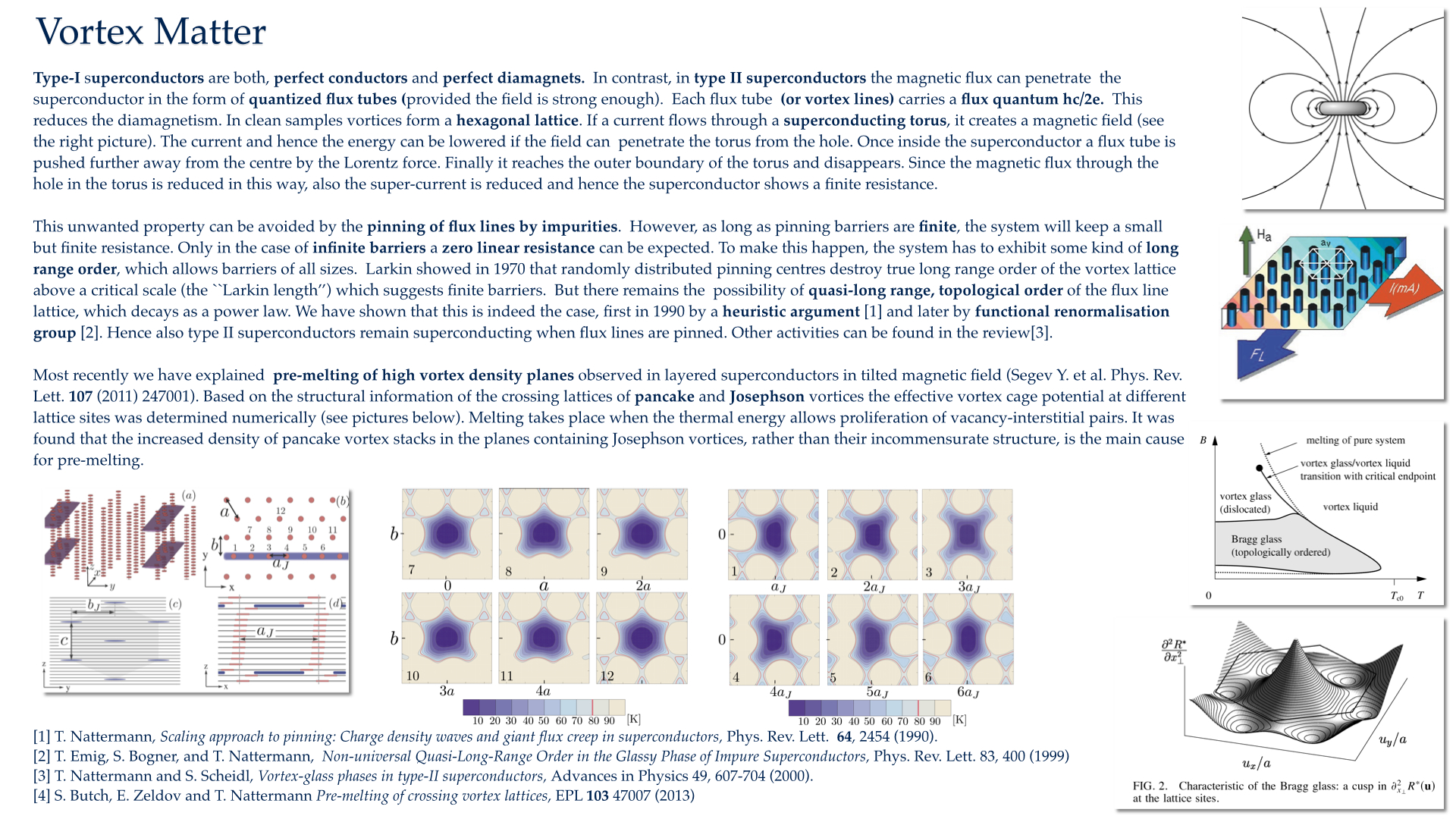
Type-I superconductors are both ideal conductors and perfect diamagnets. On the contrary, type-II superconductors show for sufficiently strong fields a "mixed" phase, in which the magnetic flux can penetrate the sample in the form of quantized flux lines. Any external transport current induces then motion of flux lines which results in dissipation. Hence the perfect electric conductivity is lost. In high-Tc materials this field region covers essentially the whole superconducting phase (for an introduction into superconductivity, see [1]).

To prevent dissipation flux lines have to be pinned by impurities. It is now widely accepted, that the presence of randomly distributed impurities leads to the formation of a glassy state of the flux line array, the "vortex glass", in which the linear resistivity of the superconductor vanishes because of arbitraryly high pinning barriers (see [2][3] for recent reviews).

One type of vortex glass in superconductors with point defects has been established so far: The elastic "Bragg"-glass [4]-[8], which is a phase with quasi-long range topological order of the Abrikosov-lattice. It could be also called a "positional glass" since its properties are defined in terms of the vortex degrees of freedom. Another definition of vortex glass uses the possibility of glassy order of the phase of the Ginzburg-Landau order parameter [9] and can be called "phase coherent" glass [3]. Gauge glass models show this type of order.

One of the currently investigated questions is the relation between positional and phase coherent glass. Others are related to the influence of the layer structure of high-Tc materials on the formation of glassy states.

In order to understand the resistive behavior of type-II superconductors, it is important to study the nonequilibrium physics of vortices in dependence of the current, temperature and disorder. In equilibrium disorder turns a vortex lattice into a vortex glass, but what is the nature of the driven vortex system? To what extent is the positional order influenced by the driving force, is the vortex system a solid or is it more a liquid? These questions, as well as the possibility of nonequilibrium phase transition between different states are examined in Ref. [10,11]. The dynamics of dislocations, which are of particular importance for the topological order in the vortex system is examined in Ref. [12,13]. While the study of these questions leads to interesting results already for a stationary driven state, the phenomenology of nonstationary states (i.e., when the current changes in time) is even more rich and has been addressed in Ref. [14,15].

Recent measurements on BSCCO show, that the first-order melting transition that is believed to separate between Bragg glass and liquid phase extends to much lower temperatures than believed before and display a unique phenomenon of inverse melting [16]. They also give a thermodynamic evidence of the existence of a new true second-order phase transition within glass phase [17,18].
The nature of the vortex matter phase transitions and structure of the phase diagram are now of fundamentel interest.


references:
[1] M. Tinkham,
Introduction to Superconductivity,
McGraw-Hill NY, 2nd edition 1996.
[2] G. Blatter et al.,
Vortices in high-temperature superconductors
Rev. Mod. Phys. 66, 1125 (1994).
[3] T. Nattermann and S. Scheidl,
Vortex-glass phases in type-II superconductors
Advances in Physics 49, 607-704 (2000). [cond-mat/9805400]. [PDF]
[4] T. Nattermann,
Phys. Rev. Lett. 64, 2454 (1990).
[5] S. E. Korshunov, Phys. Rev. B48, 3969 (1993)
T. Giamarchi and P.Le Doussal, Phys. Rev. Lett. 72, 1530 (1994), Phys. Rev. B 52, 1242 (1995).
[6] T. Emig, S. Bogner, T. Nattermann,
Nonuniversal Quasi-Long-Range Order in the Glassy Phase of Impure Superconductors .
Phys. Rev. Lett. 83, 400 (1999).
[7] J. Kierfeld, T. Nattermann and T. Hwa,
Topological order in the vortex-glass phase of high-temperature superconductors.
Phys. Rev. B 55, 626 (1997).
[8] J. Kierfeld,
Topological order in the phase diagram for high temperature superconductors with point defects.
Physica C 300, 171 (1998).
[9] M. P. A. Fisher, Phys. Rev. Lett. 62, 1415 (1989),
D. S. Fisher and M. P. A. Fisher and D. Huse, Phys. Rev. B 43, 130 (1991).
[10] S. Scheidl and V.M. Vinokur,
Driven Dynamics of Periodic Elastic Media in Disorder .
Phys. Rev. E 57, 2574 (1998).
[11] S. Scheidl and V.M. Vinokur,
Dynamic Melting and Decoupling of the Vortex Lattice in Layered Superconductors .
Phys. Rev. B 57, 13800 (1998).
[12] S. Scheidl and V.M. Vinokur,
Gliding Dislocations in a Driven Vortex Lattice .
Phys. Rev. B 56, 8522 (1997).
[13] I. Aranson, S. Scheidl, and V.M. Vinokur
Nonequilibrium dislocation dynamics and instability of driven vortex lattices in two dimensions .
Phys. Rev. B 58, 14541 (1998).
[14] S. Scheidl and V.M. Vinokur,
Hysteretic creep of elastic manifolds .
Phys. Rev. Lett. 77, 4768-4771 (1996).
[15] V. Metlushko, U. Welp, I. Aranson, S. Scheidl, V.M. Vinokur, G.W. Crabtree, K. Rogacki, and B. Dabrowski,
Driven vortex states and relaxation in single Crystal YBa2Cu4O8.
preprint (1998), cond-mat/9804121.
[16] N. Avraham et al.,
'Inverse' melting of a vortex lattice
Nature 411, 451-454 (2001)
[17] H. Beidenkopf et al.,
Equilibrium First-Order Melting and Second-Order Glass Transitions of the Vortex Matter in Bi2Sr2CaCu2O8
Phys. Rev. Lett. 95, 257004 (2005)
[18] H. Beidenkopf et al.,
Interplay of Anisotropy and Disorder in the Doping-Dependent Melting and Glass Transitions of Vortices in Bi2Sr2CaCu2O8
Phys. Rev. Lett. 98, 167004 (2007)


last update 2011-04-14 by Sebastian Butsch